Home > Efficient cleaning of scaffold planks for reuse

Efficient cleaning of scaffold planks for reuse

Mechanical brushing replaces manual cleaning, increasing capacity while preserving the quality of scaffold planks for reuse.

Send to colleague
Send to colleague

Key principles behind the achieved results

From manual work to efficient cleaning

Planks return from construction sites covered in dirt, weathering and cement residue, making cleaning a challenge.

Focused cleaning

The goal is to remove contamination without structuring or damaging the wood surface.

Higher capacity

Processing multiple planks at once significantly increases throughput and efficiency.

The challenge

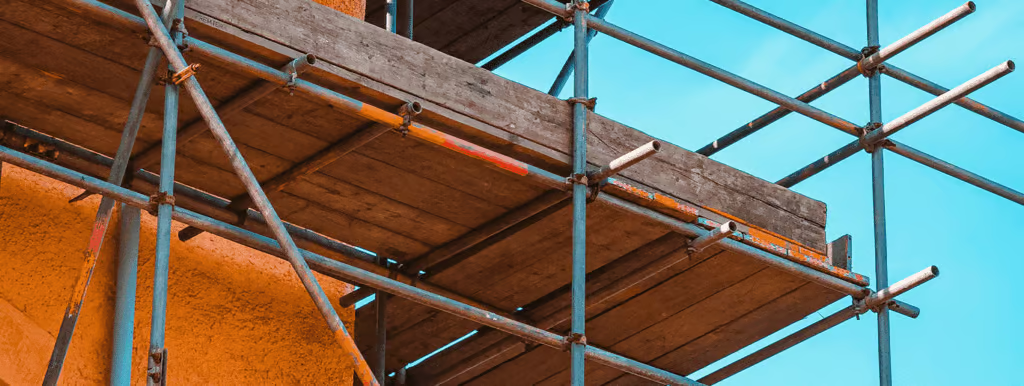
Used scaffold planks returned from construction sites heavily contaminated with dirt, weather exposure and cement residues. Especially the cement haze made cleaning difficult. The process was fully manual, involving scraping and sanding, which was time-consuming and labor-intensive, particularly given the length and volume of the planks.

The approach

The solution focused purely on cleaning, not processing the wood. After testing different options, a Tynex 120 brush with a short filament was selected to effectively remove dirt and cement without affecting the surface. The machine was configured with brushes above and below, allowing both sides of the plank to be cleaned in a single pass. With a working width of 600 mm, two to three planks can be processed simultaneously. Lower line speeds improve the cleaning result, especially for heavily contaminated material, while keeping the process simple for the operator.
The result

The transition from manual to mechanical cleaning significantly improved efficiency. The process requires less labor, increases throughput and delivers consistent results. Planks can now be cleaned faster and reused more effectively, reducing waste and improving overall productivity.

“What used to take a lot of time and effort is now a streamlined process. We can handle higher volumes with less work and consistent results.”

Related projects

Facing texturing variation in production?

Explore how different brushing applications handle variability in industrial environments.

Contact

Lets talk about your project

Get in touch for questions, advice, or support

Or call us via +31 (0)512 510035.

Trivec communicates primarily in Dutch and English.

Quote

Request a quote

Get in touch for questions, advice, or support

Or call us via +31 (0)512 510035.

Trivec communicates primarily in Dutch and English.

Contact

How can we help?​​

Get in touch for questions, advice, or support

Or call us via +31 (0)512 510035.

Trivec communicates primarily in Dutch and English.