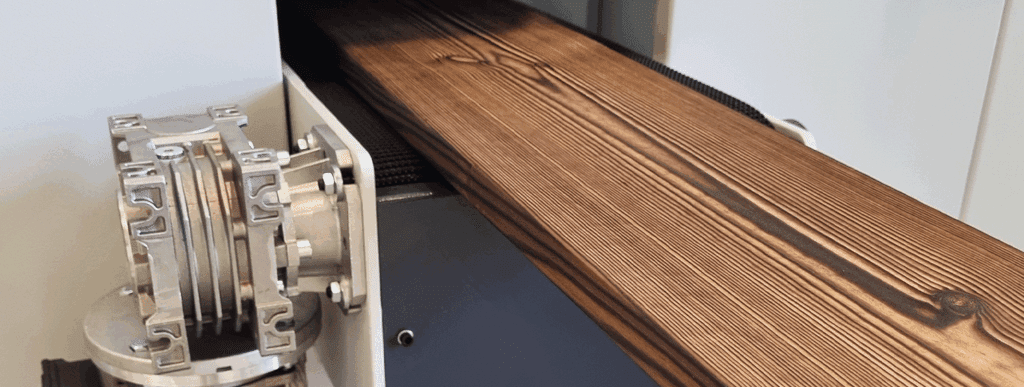
Texturing
Texturing is used to level surfaces, remove machining marks, and prepare materials for further finishing or coating. Consistency becomes increasingly challenging as material variation and production speed increase.
Sanding
Controlled mechanical brushing used to open wood grain, remove machining residue, and achieve a consistent surface texture across boards and profiles.
Wood cladding
Large visible surfaces and outdoor exposure require controlled surface structure and repeatable finishing results.
Beams
Structural wood elements demand uniform surface treatment across varying dimensions and material characteristics.
Parquet
Natural wood variation combined with high visual expectations makes surface consistency and coating behavior critical in parquet production.
Interior components
Interior applications rely on consistent surface appearance and tactile quality across a wide range of product types.
Brushing is influenced by materials, processes, and production constraints. In our Knowledge Center, we share practical insights, explanations, and best practices to help you better understand brushing challenges and possible approaches.
Welcome to WordPress. This is your first post. Edit or delete it, then start writing!
View blog
Clear explanations of texturing, brushing, polishing, and cleaning processes, and how they influence surface quality.
Insights into recurring brushing issues across industries and why they occur in production environments.
Examples of how brushing challenges are addressed by focusing on process control rather than individual machines.
If these topics reflect challenges in your production, discussing your specific situation is the next logical step.
Get in touch for questions, advice, or support
Or call us via +31 (0)512 510035.
Trivec communicates primarily in Dutch and English.